Charlie’s Body Found and Identified in the Glenwood Basement
The Birthday PartyCharlie Hamilton’s body is found concealed beneath a recently repaired section of concrete in the basement of the unfinished Glenwood renovation house. The discovery begins not with visible remains but with a tiny red fragment trapped in the floor, a clue that connects the building to Charlie’s red party dress. DNA later confirms the child’s identity. The search thus turns a missing-person case into a death confirmed, while making the family secrets surrounding Charlie’s parentage and care newly painful.
The Clue in the Basement
The discovery unfolds during a search of the empty house belonging to Mitch Hamilton and Scott Bowers. The building is still under renovation: upstairs, parts of the floors are missing and boards lean against the walls. Outside, rain darkens the day, but the basement is sealed from the weather and has no windows. Its power has not yet been connected, so the man checking it switches on his phone’s flashlight and sends Detective Brown a message to say he is at the house.
The basement appears largely bare. A few unopened paint cans stand in one corner, and one has to be shifted before the searcher notices something caught beneath it. At first the speck seems like lint. It will not move when he blows on it, nor can he pull it free. The floor around it is visibly different from the rest of the basement: the concrete is newer, uneven in places, and looks as if it has been repaired recently. In the flashlight beam, the speck resolves into a small piece of red material submerged in the concrete.
That fragment changes the meaning of the room. Charlie wore a red dress at the birthday party, so the material is not simply debris from a renovation. It is a physical trace of the missing child embedded in the floor. The man tries again to tug it loose, but it remains trapped. He understands that the repair may have covered something far more terrible than a flaw in the concrete and is left confronting the possibility that he is kneeling above Charlie Hamilton’s grave. The body is not exposed in this initial discovery; the clue is the fabric, fixed in place beneath the surface.
From Suspicion to Identification
The sequence makes the confirmation a process rather than a single revelation. The altered concrete first indicates that something in the basement has been concealed. The red fragment then links that hidden space to Charlie’s clothing. What had been an unfinished house, its paint cans and repaired floor ordinary features of renovation, becomes evidence of a burial. The scene’s restricted light and the piece of fabric that cannot be lifted make the concealment materially present before the remains themselves are confirmed.
Later, Chase brings the identification to Megan Carter, Kathy Hamilton, and Fay Hamilton at home. He tells them that Megan’s daughter has been found and that DNA has confirmed her identity. Charlie was encased in concrete in the basement of Mitch and Scott’s empty house. This announcement closes the central uncertainty of the search: the child whose whereabouts had been unknown is dead, and the remains belong to Charlie. The earlier suspicion prompted by the red material is no longer only a possibility.
The setting also gives the confirmation a particular force. Charlie’s remains were hidden inside a house still being worked on, beneath a repair that made the basement look newly finished in one corner. The construction work did not erase the trace completely; a piece of the red dress remained visible enough to be noticed. The discovery therefore turns the house’s unfinished state into part of the evidence: the repaired patch, different in color and uneven at its edges, marks an attempt to cover what the surrounding room did not reveal.
A Family History Exposed by the Loss
Charlie’s identification arrives against a history of secrecy about who she is and how she came to live with the Hamiltons. During questioning, Kathy had told Chase that Charlie was adopted and had been living with her and Mitch for only six months. Mitch objected angrily to Kathy’s disclosure, but Kathy believed the police would learn the truth eventually. Her admission exposed that the family’s public account did not explain Charlie’s full history.
Kathy had also told Megan that Mitch’s brief relationship with a younger woman had resulted in a daughter, and that he had visited the child monthly for five years without Kathy knowing. The child’s surname was changed to Hamilton, and the arrangement was presented as an adoption. These facts do not make the discovery in the basement less direct: DNA identifies Charlie. They do, however, place her death inside a story in which biological ties, a changed surname, and the family that raised her had been kept apart by concealment.
Megan’s own history echoes that pattern. She tells Kathy that she was adopted as a baby and had believed Jeanette was her mother. After Susan reveals the name of her birth mother, Megan tells Kathy that her real name is Hope Hamilton. The parallel is not that the two women share the same experience in every respect, but that both Charlie’s and Megan’s identities have been shaped by information withheld and by the names through which their families were understood. Charlie’s confirmed death makes those hidden connections part of the grief the family must now acknowledge.
The News and Its Aftermath
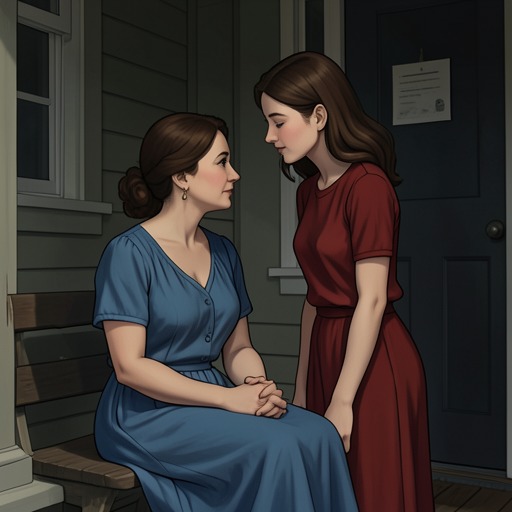
When Chase delivers the news, Megan’s distress is already visible in her bloodshot eyes and the fresh breakouts on her cheeks. She recoils when she sees him, then steps aside and lets him into the kitchen. Kathy has an arm around Fay. After Chase tells them about the DNA confirmation and the concrete in the basement, Kathy and Fay embrace Megan. Megan says she has many questions but cannot ask them then; she covers her face and breaks down. The finding changes the immediate task from searching for Charlie to mourning her, while leaving Megan unable to process the confirmation all at once.
The aftermath later gives Megan a place to speak to her daughter. At the cemetery, she says she is glad to have somewhere to come and talk to Charlie. Mitch tells Megan that Charlie was lucky to have had her as a mother and recognizes the difficult decision to let Charlie live with the Hamiltons when Megan could not care for her herself. Kathy then asks whether Megan would accept her changing her surname to Carter. She says that she wants to do it, but asks her father whether it is all right; the exchange presents the change as a wish, not as an already completed act.
The proposed name change is a small but consequential response to the concealments surrounding Charlie. The DNA result establishes the child’s identity, while the cemetery becomes a place where Megan can address her as her daughter. Kathy’s wish to take Megan’s surname gestures toward kinship through recognition and connection, rather than treating the family story as settled by biology or legal labels alone. The basement discovery ends the uncertainty about Charlie’s fate; its consequences continue in the living family’s effort to name their relationships and make room for grief.